Lead Distribution and Dispute Resolution Systems
Lead Distribution Systems
Lead distribution is where most agencies fail to scale. Because manual processes don’t survive pressure.
When lead volume increases, time zones widen, and buyer expectations rise, manual forwarding introduces inconsistency, and delays. What worked at five leads a day quietly breaks at ten, and completely implodes at twenty and more.
This is why lead distribution is not an operational detail. It is core infrastructure.
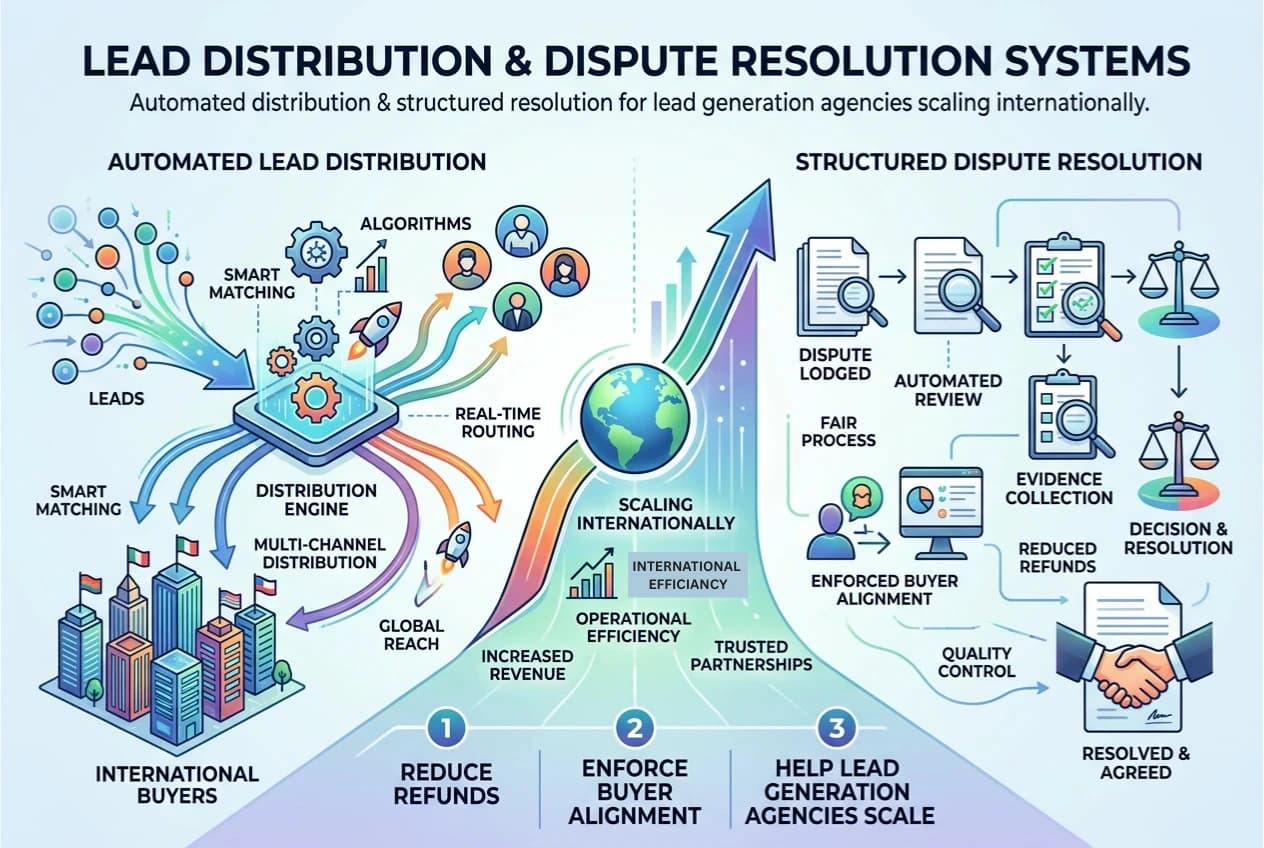
Why Manual Lead Distribution Breaks Down
Manual lead forwarding fails for predictable reasons:
- Leads are delayed while someone decides who should receive them
- Human errors quickly multiply when manually routing
- Volume = disaster. When in reality you want to deliver more leads
- Disputes verification, management and refunds become more complicated
In international operations, these issues multiply. Time zone gaps, handoffs between team members, and asynchronous communication introduce friction that cannot be solved with effort alone.
Manual systems depend on people behaving perfectly under pressure. Infrastructure assumes they won’t.
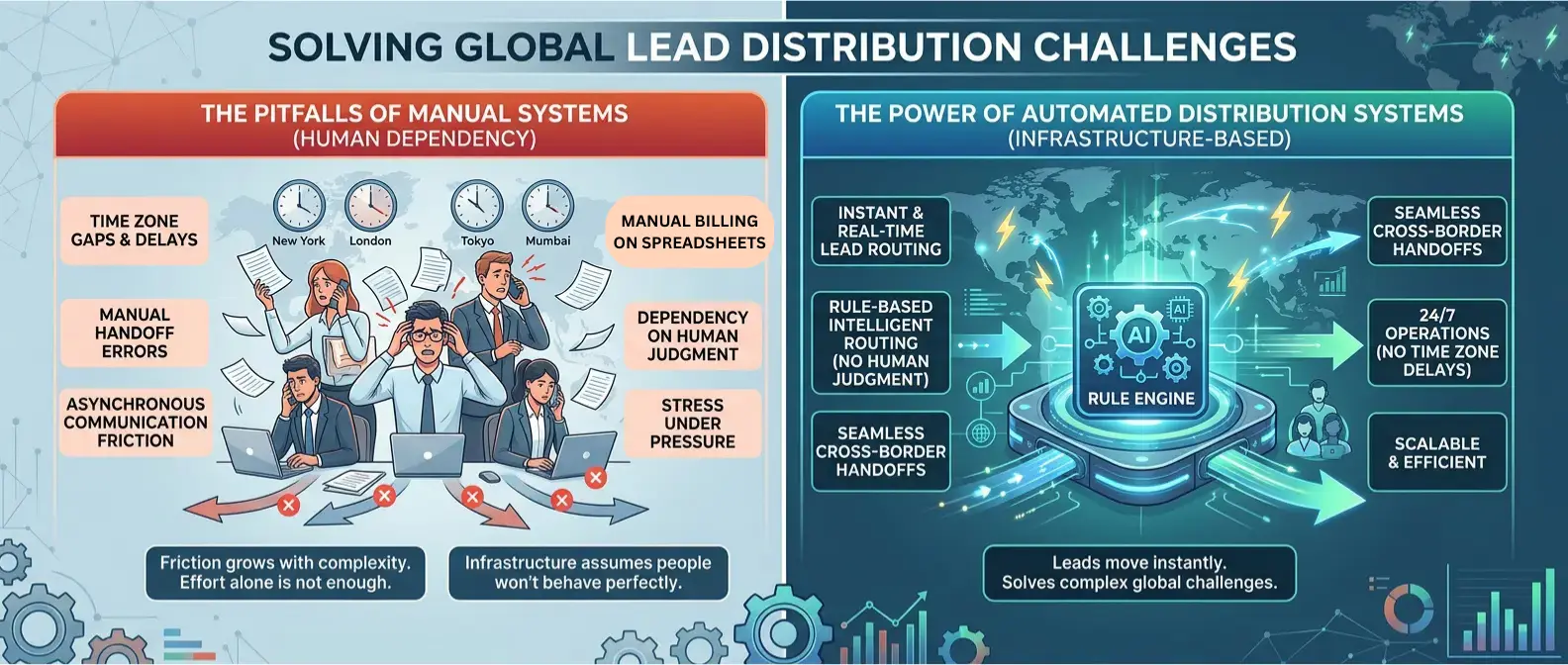
Automated distribution systems ensure leads move instantly based on rules, not human judgment.
Distribution Must Be Rule-Based, Not Reactive
A dedicated lead distribution system removes subjectivity entirely.
Platforms like LeadSwitchboard route leads based on predefined rules rather than human judgment. These rules are set once and enforced consistently.
Common routing criteria include:
- Buyer geography
- Lead type or job size
- Buyer preferences
- Wallet balance or spend limits
- Priority or performance tiers
When routing is automated, leads move instantly. No waiting. No second-guessing. No bottlenecks.
Speed improves not because people work faster, but because people are removed from the critical path.
Alignment Prevents Refunds
One of the biggest drivers of disputes is misalignment.
Buyers dispute leads when they feel the lead never matched what they agreed to receive. Manual distribution makes this easy to get wrong because preferences live in people’s heads, inboxes, or spreadsheets.
Automated distribution systems enforce alignment at delivery.
Buyers receive leads that match:
- The geography they selected
- The categories they opted into
- The pricing rules they accepted
This clarity reduces disputes before they occur. Expectations are no longer implied, they are enforced.
Wallet-Based Delivery Separates Money From Emotion
Wallet-based lead delivery is a structural upgrade.
In this model:
- Buyers pre-fund wallets
- Leads are delivered automatically
- Credits are deducted at delivery
- Lead flow continues uninterrupted
- Refunds happen with a click
This separation of payment and delivery eliminates collection friction entirely. Agencies no longer chase payments. Buyers are never surprised by invoices.
More importantly, disputes no longer threaten cash flow.
Why Wallets Protect Both Sides
Wallet-based systems protect agencies and buyers simultaneously.
For agencies:
- Revenue is somewhat predictable
- Cash flow is stable
- Operations are uninterrupted
- No manual invoice generation and forwarding
For buyers:
- Spend is controlled
- Delivery is transparent
- No surprise charges appear later
This structure shifts the relationship from adversarial to collaborative. Both sides operate within known constraints enforced by the system.
Disputes Are Inevitable
No matter how good your leads are, disputes will happen.
What determines scale is how disputes are handled.
Without a structured dispute system:
- Buyers escalate emotionally
- Staff respond inconsistently
- Decisions feel arbitrary
- Trust erodes quickly
Automated dispute workflows set expectations upfront. Buyers know:
- What qualifies as a valid dispute
- How disputes are submitted
- How they are reviewed
- What outcomes are possible
This removes ambiguity before conflict arises.
Data Replaces Debate
Structured dispute systems rely on data, not opinion.
Call logs, timestamps, response times, and routing records provide objective context. This transforms disputes from arguments into evaluations. In the lead generation and supply business, lead buyer disputes are governed by - Speed to Lead aka how fast is your customer contacting the lead. Time taken to initiate the first outreach is critical data in determining if the lead is genuinely bad OR your customer took too long to dial the lead.
When buyers know disputes are reviewed based on data, behavior changes:
- Faster response times
- Fewer frivolous claims
- Higher accountability
Transparency disciplines behavior without confrontation.
Emotional Decisions Don’t Scale
Refunds handled emotionally destroy consistency.
One buyer gets refunded. Another doesn’t. A third escalates. Over time, internal rules erode, and staff begin improvising. This inconsistency fuels more disputes, not fewer.
Systems enforce fairness precisely because they remove emotion.
The same rules apply at ten leads a day and ten thousand.
Trust Is a System Outcome
Trust does not scale through relationships alone.
Relationships help early on. But as volume increases, trust is built through predictable behavior:
- Leads arrive when promised
- Billing behaves consistently
- Disputes follow clear rules
- Decisions are documented and repeatable
When systems behave the same way under pressure, confidence grows even across borders.
The Bottom Line
Lead distribution and dispute resolution are trust infrastructure.
Manual systems fail quietly until they fail catastrophically. Automated systems fail loudly and early, allowing correction before damage spreads.
In international lead businesses:
- Distribution must be rule-based
- Payments must be decoupled from emotion
- Disputes must be structured
- Trust must be enforced by systems
The trick is to scale with infrastructure that behaves consistently, especially when things go wrong.
Read Next: Complete Guide on How to Start a Lead Generation Agency and Sell Leads Globally
Automate your lead distribution and scale without manual work.
LeadSwitchboard makes it all work together. One platform for everything.